Showing posts with label mystery. Show all posts

Monday, April 14, 2014

Ahí va el diablo (2012)

Directed by: Adrián García Bogliano

Writer: Adrián García Bogliano


The very first scene in this film has two lesbians banging the hell out of each other. You can hardly imagine a more promising start of a movie, but things get better. After they've finished (and had a boring conversation no one cares about anyway), one of them goes down the stairs to answer the door, only to be brutally killed by an extremely large guy who cuts off a few of her fingers in the process. Her girlfriend then comes down and hits the killer in the head with a heavy object, so he gets really pissed off and leaves. The dying girls murmurs something about "his eyes" before shuffling off this mortal coil. You may think there's hardly a more promising beginning to a movie than a lesbian sex followed by a murder, but it gets better.

The killer, still in a bit of a knockdown, manages to get to a nearby mountaintop, where he opens a sack out of which falls a myriad of severed fingers (!). Then he removes his clothes and proceeds with doing what suspiciously looks like a sexual intercourse. With the ground. Yep. A bit later, apparently on the same mountain, we find a nice little Mexican family with two young children. They spend some time there and then leave, but the kids (a boy and a girl, by the way) want to go back for some reason, so the parents let them go so they can have some hot sex in the car. The parents, not the kids, you sick bastards. The mother gives her daughter a wristwatch and warns her that they have to be back in an hour. Surely, what could possibly go wrong?

Well, as you might have imagined, the kids don't return (surprise, surprise!), the parents are pissed off at each other and some unpleasant family stuff comes to the surface etc. But lo and behold, the following day the kids are back, perfectly unharmed, their whereabouts and doings remaining a mystery. Which, by the way, is not very surprising, as absolutely no one bothered to, you know, ask them where they were. Anyway, long story short, the kids are apparently alright, but soon strange things start happening (details of which will remain undisclosed in this review), and that prompts the mother to think that there might be something wrong with the children. (Cheesy announcer mode on:) What she will discover is that the truth is more horrifying than anything she might have imagined (cheesy announcer mode off).

The screenplay of this film is rather uneven. On one hand, the parts with the (apparently children-related) strange phenomena leave a lot to be desired. We see absolutely nothing we haven't already seen in many ghost movies. Hardly anything interesting happens about that. On the other hand, the movie compensates for that in some rather unexpected places. For example, the parents discover the whereabouts of a guy whom they suspect might have sexually assaulted the kids and they decide to pay him a night visit. Suffice it to say that it ends in a pretty surprising way. 

The story is made on the anything-goes principle, many things are not well explained, some of them are downright illogical and in general it all doesn't make much of a sense. I'm certainly no logic Nazi and I thought a good mysterious atmosphere was more than enough compensation, but still many people will probably see this as a serious fault.

To me much bigger problem were the kids. It seems as if the director had never seen The Omen, otherwise he would have known how a scary kid looks like. These two are not a tiny bit scary, if anything they look more drugged than demon-possessed or something. Don't let that chase you away from the movie, though. With all its faults, Here Comes the Devil is a very nice movie whose atmosphere and occasional extreme weirdness fully compensate for certain shortcomings. Actually, I lied in the first paragraph. Lesbian sex is much better than murder, cutting off fingers and raping the ground.

Tuesday, March 11, 2014

La cara oculta (2011)

Directed by:  Andi Baiz

Writers: Hatem Chraiche Ruiz-Zorilla, Andi Baiz (screenplay), Hatem Chraiche Ruiz-Zorilla, Arturo Infante (story)


If by any chance this is the first time you hear about this movie, immediately proceed with the following steps:

1) Read the rest of this text (it's completely spoiler free),
2) By all means avoid watching any trailers or reading any spoiler non-free reviews,
3) Promptly get the movie and watch it immediately because it absolutely rules!

Here's roughly what happens in the first half an hour or so: This guy Adrian, a young (and apparently very attractive to women, lucky bastard) Spanish orchestra conductor, gets dumped by his girlfriend Belen via a video message. Completely dumbfounded, he goes to a bar to drown his sorrow and there he meets a hot as hell young waitress called Fabiana, whom he promptly picks up, because he can. Lucky bastard. You would think he would spend some time mourning his previous relationship, but noooooooooooooo sir, this girl (whose hotness I can't stress enough) moves with him in what seems to be a matter of days. Lucky bastard.
 
Anyway, what I should mention is that all this takes place in a large house in Colombia, near its capital Bogota, the house which Adrian rents because he prefers the peace and quiet of the country to the city's... whatever the hell is the opposite of peace and quiet. To get back to the story, Adrian may have solved the lack of girlfriend problem, but other troubles kick in. First of all, the police are on his trail - as Belen apparently had never left the country, she's pronounced missing and guess who's the prime suspect? As if that wasn't enough, strange things happen in the house, mainly in the bathroom when Fabiana's using it (which, fortunately for us, she does quite often). Strange noises, water turning hot for no apparent reason, waves in the water in the sink when it should be perfectly still, et cetera, all that prompts Fabiana to think the house may be haunted. That's more than enough to give stress even to someone who picks up women so easily as Adrian, lucky bastard.
 
While this may sound rather mundane, the movie's structure and things that happen after that are anything but. Fabiana is scared of the house, but she also suspects that Adrian may still love Belen, he reassures her, blah blah, and than suddenly we see a ghostly face in the mirror and we are thrown back in time to get the explanation for all that's happening. We see Belen and Adrian, apparently a very happy couple, moving from Spain to Colombia because of his job and renting that awfully big house from some German lady. But that house also has a very interesting secret, which will become known to Belen during a conversation with the landlady, and it will kick everything in motion. Prepare yourself for a wonderfully conceived and directed story that's full of twists, it grabs you and won't let go until the ending, but also be prepared for a big emotional investment. I'm not talking about some teenage melodrama crap - this movie will have characters fall into grave dangers because of completely stupid small mistakes and you will probably very often find yourself rooting for them to overcome them. "No, no, watch that, watch it... nooooooooooooooooooo!!!!", "The mirror, look in the mirror!!! Yesssssssssssssssss!!!", "What the hell are you doing, you stupid bitch!!!??!?!?!?!?!" are some of the comments I made during some of the more tense moments in the film.
 
I simply cannot recommend this movie enough. If the greatly written and original story enhanced by good performances is not enough for you, then two beautiful female leads should persuade you. By the way, if you've seen this film and liked it, by all means check out the wonderful French film with Audrey Tautou called He Loves Me, He Loves Me Not, which has a structure similar to this movie (same events shown from the perspectives of two main characters, where the shift of perspectives suddenly gives a very dark tone to what we have seen previously).

Sunday, February 16, 2014

The Kovak Box (2006)

Directed by: Daniel Monzón

Writers:  Jorge Guerricaechevarría, Daniel Monzón


Timothy Hutton plays a sci-fi writer who arrives on an island in Spain to participate in a conference or something. Everything's wonderful at first, but strange things quickly start happening. First there's a mysterious and disturbing video sent to him to his hotel room, then the unexplainable suicide of his girlfriend, who jumps off a window for no apparent reason. Just as Hutton's about to leave the island, he meets a young girl who also attempted suicide in the same way as his girlfriend. She claims that someone's after her. At first Hutton doesn't believe her, but then there's another suicide right on the airport, so they join forces in an attempt to find out whoever the hell wants to kill her and discover what the hell is going on.
 
This is one of those mystery movies that are wonderful at the beginning, when there's a building tension, a sense of paranoia, conspiracy and all that stuff. It's also competently directed and the characters are likeable. However, as it usually happens, the mystery itself is much more interesting than its solution. Once we find out the reason behind all that, it boils down to a rather conventional bad guy vs. good guy showdown. Near the end there's a potentially great mass suicide scene that unfortunately wasn't directed very well, so its impact (and the one of the movie itself) was greatly reduced.


Friday, February 14, 2014

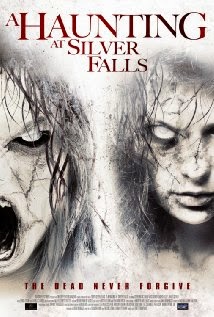
A Haunting At Silver Falls (2013)

Directed by: Brett Donowho

Writers: Cam Cannon, Rachel Long, Brian Pittman


This starts off like a fairly standard ghost picture. Our heroine is a young girl who lost her parents, so she's staying with her aunt and her husband and one night she finds a ring that she puts on and can't take off later. Immediately after that she starts having a heavy case of ghost haunting - apparently, she's being chased by the spirits of two long gone twin sisters who want their damn ring back.
 
She's not exactly getting along with her aunt (or anyone else, come to think of it) and her only solace is a her nerd boyfriend who's a spitting image of a teen version of Eli Roth. However, soon it turns out that the spirits that haunt her don't mean harm - in fact, their father had been wrongfully accused for killing them and they are trying to lead her to the real perpetrator.
 
To me this idea was very appealing. With everyone (especially her relatives) acting more and more strange, it soon turns out that the only persons she can trust are - the dead twin sisters. It doesn't happen very often that you root for ghosts against the living people, so this movie has a point for originality because of that. Also, I quite liked the middle part of it, because it had a very nice kind of tense atmosphere where everyone seemed to be after our heroine.
 
However, everything falls apart at the ending, which is confusing and leaves heaps of questions unanswered. It's not the Michael Haneke kind of open ending, where you have to figure out what happened yourself (like in Hidden, for example) but rather a shining example of sloppy writing.
 
Still, this all makes for a rather pleasant and interesting viewing. If you liked this movie (and even if you didn't) I heartily recommend you watch Frank LaLoggia's Lady in White, a wonderful little film with somewhat similar story in a more Stephen King-like setting.

Friday, February 7, 2014

Kairo (2001)

Directed by: Kiyoshi Kurosawa

Writer: Kiyoshi Kurosawa


When there's no more room for ghosts in the next world, the living will start commiting suicides and turning into black spots on walls, at least that's what Kiyoshi Kurosawa tells us in this slow, atmospheric and frustratingly complicated film. The main problem with this movie is that it doesn't go for the cheap jump scares and shameless exploitation of long-haired ghosts (though it does have some of that), but instead tries to make a clever statement about human loneliness and how modern technology is separating us and crap like that. It also has some features of an arthouse film, like when you have absolutely no idea what the hell is happening and why is everyone doing whatever the hell they're doing.
 
The story begins with a suicide of some guy. But, not only did he kill himself, he also turned into a black spot on the wall. At the same time, some other guy stumbles upon a scary website that promises their visitors interaction with the dead (!). At the same time, there's a scary mysterious room that harbours a horrifying secret. Some friends try to investigate what's going on, but they can do little to prevent the bizarre series of suicides that threatens to make the entire world (or at least Japan) look like Pripyat, Ukraine.
 
I found this movie incredibly difficult to follow. I don't know whether the problem was with the subtitles, or the director in most scenes didn't try too hard to establish the location, or I'm just stupid - anyway, I had mostly no idea who these people were and where did this all take place. And it's all so sloooooooooooooow and sloooooooooooooow and it's bearable for the first half an hour because there's an occasional scare here and there (like the first visit to the Forbidden Room, that one was spine-chilling) and you still have hope that things will actually resolve or something. However, from there on, it just seemed to me that Kurosawa was making some kind of style exercise, for himself rather than for the audience and I almost completely lost interest.

The last part of the movie has some nice apocalyptic images and this is the first movie I've seen that combines a J-horror with an actual apocalypse in such a direct way. It's a great idea, but I would've preferred it to be realized in a more conventional story. I'm not saying this movie was bad, of course. It was just a bit too hermetic for my taste, but if you like the films of, say, David Lynch, by all means I recommend you give it a try.

Sunday, November 3, 2013

In 3 Tagen bist du tot 2 (2009)

Directed by: Andreas Prochaska

Writers: Agnes Pluch, Andreas Prochaska


In 3 Tagen bist du tot was a completely generic Austrian slasher without a single trace of innovation over the already infinitely repeated formula. I was pretty confused when I heard about the sequel, wondering what could they possibly do to make it even less original than the first film (since, as we know, that's what sequels are for). For better or for worse, Andreas Prochaska decided to make a completely different film. While the first part was about a bunch of teenagers getting offed one by one by a mysterious killer, this one puts one single character in a situation heavily inspired by The Texas Chain Saw Massacre and similar films.
 
It's one year after the events of the first film and Nina, the heroine, tries to put the traumatic death of all her friends behind and lead a normal life. However, she receives a mysterious call for help from Mona (the only other survivor, it's the one that impaled herself in the first film, unfortunately without success). She promptly returns to her hometown and finds that Mona and her father have left home, which is now inhabited by some Chinese people. Continuing with her quest, Nina will find herself in an isolated hotel run by a family of weirdos and will have to use all her skills to survive.
 
The first part of the film plays like a pretty nice mystery, with director Andreas Prochaska taking things slowly and using the wonderful Austrian winter landscape to create some memorable shots and accentuate the lead character's isolation and crap like that. However, while this is by no means bad, whoever watched the first film will want to see some killings and it takes almost 70 minutes for the first person to bite the dust. Also, even outside of the subjective perspective of a bloodthirsty slasher fan, the first hour definitely contains some overlong scenes which serve no purpose.
 
Fortunately, things get better. Immediately after the breaking of the ice, people start dying left and right and killings are really gruesome and at times very explicit (shows that Prochaska has learned quite a few things between the two films). Heads are beaten to a pulp, eyes are gouged out and don't even get me started about male reproductive organs (!). Alas, the fun part ends all too soon.
 
While by no means a masterpiece, this is a satisfying movie which even made me think it would be cool if Andreas Prochaska made another horror. The things that lower the overall grade are the aforementioned first half, which is too slow, a scene of full frontal male nudity and a scene where Nina takes a hot bath - with her clothes on! Oh yeah, there's also this cop from the first part. He doesn't run over anyone here, but he's involved in the most unconvincing scene in the film - without getting into too much detail, his car is supposed to be stuck in the snow and it doesn't look bloody stuck at all.

Wednesday, June 26, 2013

Exam (2009)

Directed by: Stuart Hazeldine

Writers: Simon Garrity (story), Stuart Hazeldine (story and screenplay)


Well, if you read the title and hoped for a horror story where an university exam quickly turns into a total carnage when a professor starts murdering the students who cheat in horribly nasty ways, you'll be disappointed to discover that's actually just a clever mystery movie that features less than 20 dead bodies. Oh, well...
 
Exam actually doesn't have anything to do with universities - it's about a job interview for an extremely powerful company. Eight candidates are put in a room and given a pencil and a piece of paper each. The invigilator, played by Colin Salmon, tells them that there's only one question and only one answer and he gives them the simple instructions: 1) Whoever damages their paper will be disqualified, 2) Whoever tries to contact him or the guard will be disqualified, and 3) Whoever leaves the room will be disqualified. I paraphrased a bit, but those are the general guidelines. However, for the candidates it is extremely important to remember (and follow) the exact way the invigilator phrased the rules.
 
The exam starts, the invigilator sets the timer to 80 minutes and leaves the room (but will reappear quite a few times through flashbacks) and the people are left alone with their papers and the guard who stands quietly by the door. Then they turn their papers to see what the question is, only to find out they are completely blank. And here's where the fun begins. It's not a simple matter of answering the question, they have to find the question first.
 
One woman starts to write something like a motivation letter and is promptly thrown out by the guard (a note for the more bloodthirsty readers: she's not decapitated, shot, or even murdered at all, just escorted out of the room). This is when the other candidates realize they have to pay extremely close attention to the invigilator's instructions. Their first discovery is that anything that's not explicitly forbidden is allowed - so they can freely talk to each other. At first they think that the infamous question must be hidden somewhere on their papers, so they start to analyse the surroundings and try to find a way to get the bloody thing to appear. If you've ever played a point and click adventure, you're on a familiar ground.
 
The strength of this movie lies not only in what its director/writer Stuart Hazeldine does, but also in what he avoids. With a setup like this, there's a number of clichés the movie could have fallen into. For example - a there-can-be-only-one type of contest where the characters discover that only one of them will win and all others have to die for some reason. Or that they all are going to die because they share some connection or a dark secret, which is the very reason why they are here in the first place. Or that the mysterious organisation is really evil and they do some weird experiments on humans or something like that. Instead, (at least for the most part) there's not a question of anyone dying - it's just about solving a mystery of the missing question and getting a job.
 
You might think this takes out a huge amount of suspense, but you would be wrong. First of all, the mystery itself is very interesting. It keeps you guessing from the first scene to the last and it packs quite a few nice surprises when our heroes come up with progressively more imaginative potential solutions, only to find them completely useless as the question stubbornly refuses to appear. So, even if human lives weren't at stake at all, we have an enjoyment of a nice little enigma without an obvious solution. However, we find out that for some of the characters getting this job is extremely important. Through some cleverly written dialogues, which give us enough information to understand the character motivation, but avoid unnecessary infodumps, we are informed that some kind of pandemic is happening outside, that many people have died, and that some of the candidates have had close encounters with the virus. The reason why they need the job is closely related to the true nature of the mysterious company, which is slowly revealed as we approach the end of the movie.
 
The story is very well written and, as I've mentioned before, is somewhat reminiscent of the point and click adventure games, where characters have to solve some problem by closely analysing their environment and, if necessary, combining different objects. The great part of its appeal comes from the way the characters are kept in total darkness as to what exactly do they have to do. They try something and it doesn't work. Then they try something else and it also doesn't work. Then another thing, and it doesn't work, too. In the process, some of them are disqualified either by making stupid mistakes, or by being tricked by someone else. Then suddenly they (and we) realize that the movie is almost over and they still haven't found the question. Is there a question at all? How many can be accepted at all? Would they all have passed if they had just sat in their places the entire time and avoided breaking the rules? So by constantly keeping you guessing about the nature of the whole thing, Hazeldine skilfully prevents you from complaining about the body count being lower than in a Yoshihiro Nishimura movie.
 
When it comes to the characters, there aren't many surprises there - there's a usual irritating I'm-so-smarter-than-you-so-I'm-gonna-boss guy who promptly takes the spotlight, along with some predictably tame women, but it will turn out that some of the other people are prepared to do much, much more than it seems at first. A nice touch here, and one that also adds to the detachment of the setting from our regular world, is that the characters avoid using real names and instead invent nicknames for themselves. When the nickname moment came, I thought "Of course, now they're gonna screw it all up and instead of using some obvious thing like skin colour, they're gonna go for some politically correct crap!", but I was again pleasantly surprised when that irritating white guy from the beginning of the paragraph immediately named them Black, White, Brown, Brunette, Blonde, etc. One of the ladies complained about this, to which I immediately yelled "Shut up!" at her, and fortunately the other characters ignored her, so the politically incorrect nicknames remained.
 
Obviously, I can't say much about the ending without spoiling it, so here are just a few general remarks: Both the mystery of the question and the point of the entire exam are explained, along with the motives of the recruiting organisation, and I liked the explanation. The nature of the question is not contradicted by anything that happened earlier in the movie, so there's no cheating on the part of the authors. So it's not one of those movies that end with another mystery (like Cube) or an earth shattering plot twist that you'll never forget as long as you live (like Saw), but the conclusion is logical and doesn't ruin the preceding events.
 
The atmosphere has a nice otherworldly quality to it. I have already mentioned the lack of character names (that always works well), but other things also must be mentioned. The soundtrack uses some great ambient music that goes very well with the progressively revealed apocalyptic nature of the whole thing. It never tries to jump in front and grab your attention, but instead does its job of providing a good atmospheric background. Second, the entire movie takes place in a single room. We get a few glimpses of the adjoining hallway, but other than that there's not a single exterior scene. The examination room doesn't have windows (obviously) and even the beginning of the movie, which shows the candidates preparing for the exam, is done entirely in close-ups, so it doesn't show any of the surroundings. It can't be stressed enough how risky this is - if you choose to put an entire movie in a single room and provide the information about the outside world only through dialogue, you can easily end up with a boring piece of crap, unless you are Alfred Hitchcock or Sidney Lumet. The fact that Hazeldine managed to pull this off speaks volumes. I'm glad that the majority of the viewers seem to share my opinion, as Exam has a pretty high IMDb rating. So, Stuart, when's the next movie coming out?

Friday, June 14, 2013

Nine Miles Down (2009)

Directed by: Anthony Waller

Writers: Everett De Roche, Anthony Waller


With its pretty high production values, Nine Miles Down was a refreshing change from the crap about which I usually write here. Unfortunately, the story didn't exactly follow, so it all boiled down to a large overall "meh".
 
The entire movie takes place in a remote drilling station somewhere in Sahara, which the security patrolman Duncan McL..., sorry, Adrian Paul, is sent to investigate after the contact with the scientists working there had been lost. As he arrives, he finds the place completely deserted, with some disturbing writings on the walls, signs of struggle and a gratuitous slaughtered jackal in one of the rooms.
 
Obviously, the first thing you want to do when you arrive at a place where something sinister had obviously happened is to spend the night there, so he does, and surprisingly he encounters no demons, ghosts or anything else during the night. However, in the morning he runs into a hot blonde scientist who just jogs around and doesn't seem horribly shaken by the things that happened.
 
Our suspicions immediately arise. Is she evil? Is she the Devil? Is the place itself evil? Is Adrian Paul insane? Why the hell is Waller showing us extreme close-ups of Adrian Paul's ass? How are sad events from Adrian Paul's past related to the horrifying visions he experiences?
 
While I appreciate some of the tension and the mystery surrounding the place and the characters, the movie simply didn't "do it" for me. Generally, when a character torments us too often with his or her visions and flashbacks and whatnot, I get bored rather quickly. Nine Miles Down wasn't boring, but I never cared about any of the characters enough to appreciate the ending or feel any bit moved by it or some crap like that.
 
One of the reasons for me not enjoying this that much might be the high expectations I had from the authors - Everett De Roche wrote some great films like Long Weekend, Razorback and Fortress (which was prevented from being one of the best films ever made only by the weaker direction), though, in all fairness, he did also write crap like Storm Warning, and Anthony Waller directed An American Werewolf in Paris, which most people hate, but for me it was great fun. Of course, this is all highly subjective, and if you read the reviews, you'll see many people enjoyed it more than I did, so... give it a shot.
 
Related Posts Plugin for WordPress, Blogger...